Commercial flat roofing is a trade with a wide gap between the firms that specify a roof and the firms that simply price one. This service exists to sit on your side of that gap. We are a commercial flat roofing specialist: we survey the roof, read it from the deck up, and connect building owners, facilities managers and estates teams with NFRC-accredited, CompetentRoofer-registered installers who carry out the work to the right standard. We are not trying to be the cheapest patch-merchant on the estate. We are trying to be the contractor who tells you what your roof actually needs and can evidence why.
This is a business built around one honest position: a commercial flat roof is not a like-for-like of a domestic one, and the cost of getting it wrong is measured in ruined stock, closed floor space and a repair bill that never ends. Everything below explains what we do, the standards the work is held to, and how the accredited-installer model protects you.
What a flat-roofing specialist actually does
A generalist roofer lists membranes. A specialist starts with the roof load and build-up profile, because that is what decides the specification. Before a system is chosen, the survey establishes the deck type (metal, concrete, timber or an existing membrane), the dead load of the current covering and insulation, the live and access loads, the wind uplift, and whether the falls drain or the roof ponds. Only then does a system make sense, chosen from the deck, the falls, the loads and how the building is used, not picked off a price list.
That approach changes the questions you get asked. Can the deck carry a ballasted array if you ever want rooftop solar. Is the insulation wet, which rules out an overlay. Was the roof ever laid to fall, or is the ponding a design fault that no patch will cure. These are the questions that separate a defensible specification from a quick sale, and they are the reason we lead with the engineering rather than the quote. You can see the full method on our how it works page.
The standards the work is held to
Every specification is worked to the current codes, not to habit. The governing standard for flat roofs is BS 6229:2025, which sets a minimum finished fall of 1:80 on most flat roofs, with the design fall derived from structural analysis or a level survey rather than a blanket rule, so the finished minimum survives construction tolerances and deflection. Where a roof ponds, that is usually because it was never laid to fall in the first place; on a re-roof the fix is normally tapered insulation, building the fall into the insulation layer without altering the structure.
A full re-roof also has to satisfy Building Regulations. Renewing more than 50% of the roof surface, or renovating more than 25% of the whole building envelope, triggers a Part L thermal-element upgrade, so the insulation is brought up to current standards, typically to a U-value around 0.18 W/m²K on a commercial re-roof (compliance is by calculation against the current Approved Document L, not a single fixed figure). External fire performance is specified to Broof(t4) where a roof is near a boundary or forms a junction with a compartment wall, and wind-uplift fixing patterns are calculated to BS EN 1991-1-4 with enhanced perimeter and corner zones. Where a warm-deck build-up is designed, a vapour control layer on the warm side controls interstitial condensation, which is what quietly rots a deck from the inside. The warm-deck re-roof page explains that build-up in detail.
The accredited-installer network model, honestly
We want to be plain about how this works, because the roofing trade is full of firms implying accreditations they do not hold. This business does not claim to be a member of any scheme. Instead, we connect you with installers who are themselves CompetentRoofer-registered and NFRC-accredited, and the work is carried out to SPRA-referenced and LRWA-referenced specifications and to BS 6229:2025. The distinction matters for two reasons.
First, competence is verifiable. Where the installer is CompetentRoofer-registered, they can self-certify the re-roof against the Building Regulations and issue a Building Regulations Compliance Certificate, the document you will need at a sale, a lease event or an insurance review, instead of a separate Local Authority Building Control application. Second, the guarantee is real. A single-point or insurer-backed manufacturer guarantee is issued because the system was installed by a manufacturer-approved installer to specification, which means it stands independently of whether any one firm is still trading. Our accreditations and guarantees pages set out exactly what the network holds and what those guarantees do and do not cover.
Coverage across England
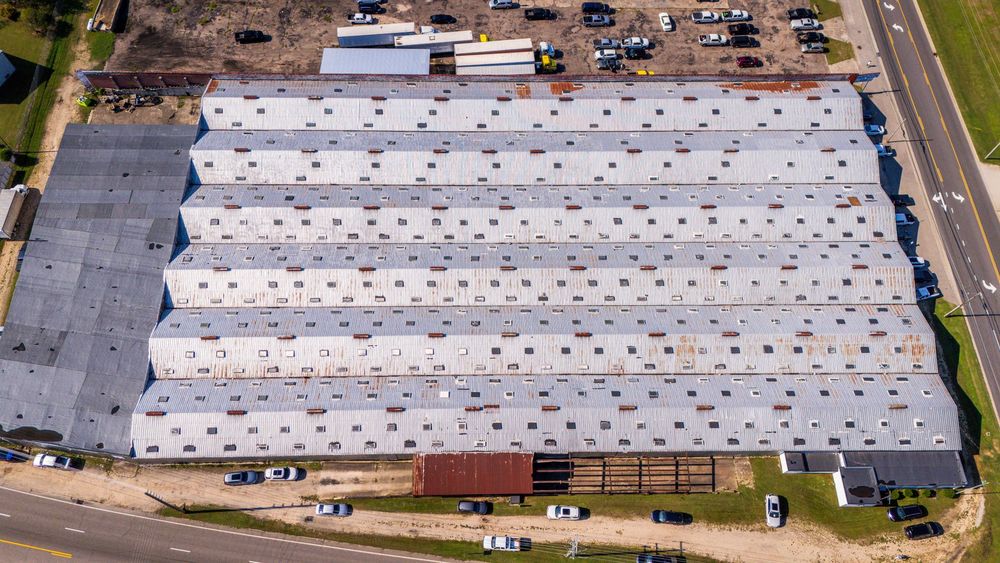
We work with building owners and installer teams on commercial flat roofs across England, from a 200 m² office deck to a warehouse roof of 5,000 m² and beyond. Typical projects run from single-ply and reinforced bitumen warm-deck re-roofs, through liquid-applied overlays on plant-congested roofs, to green and blue roofs on new developments. The common thread is that each roof is surveyed and specified individually; nothing is quoted blind from a floor area and a postcode.
Why specialism matters
The reason to use a specialist rather than a general builder comes down to whole-life cost. A life-expired roof patched reactively typically costs more over a ten-year horizon than a planned warm-deck re-roof carrying a manufacturer guarantee of up to 20 to 30 years, subject to system and approved-installer status, and that is before you count the business-interruption cost of a single major ingress: ruined stock, a closed aisle, a lost trading or teaching day. A specialist builds that comparison for you, gives you the repair, overlay and strip-and-recover options side by side with honest costs and remaining-life estimates, and phases the works across financial years where budget timing is the constraint.
That is the whole point of this commercial flat roofing service: a defensible case for your board, evidence you can keep, and a roof designed for the loads and the falls rather than for the lowest headline price. If you have a roof that leaks, ponds or is nearing the end of its life, request a free condition report and quote and we will tell you honestly what it needs.